

|
Home: Low Voltage Transformers
When To Use Low Voltage Transformers
Without transformers you would most certainly short out any electrical device not made to withstand the excess energy supplied.
Line Voltage Power In the United States 120 volt outlets are commonly found in residential homes, while 220 volts or more is often found in a commercial property's electrical supply. 120 volt house current is commonly referred to as line voltage because 120 volts is the amount of power supplied to most homes from outside electrical lines. Commerical properties on the other hand will refer to line voltage as anything 220 volts of power or more supplied by outside lines. These figures will vary based on location and the local electrical codes enforced in that area. Internationally, the line voltage power supplies will vary from place to place.
Low Voltage Power Line voltage power can be converted to supply less power to an electrical device that does not require all that power to operate. Therefore it is reduced from line voltage power to low voltage power. Low voltage power is not standardized to power most low voltage devices. Each device will have it's own power necessities for its specific device.
Using Low Voltage Transformers Low voltage lighting uses smaller more discrete lighting fixtures. These fixtures are usually sufficient and supply adequate amounts of outdoor light for most needs making installing outdoor lighting much easier. It is necessary to use low voltage transformers whenever installing low voltage lighting in any outdoor environment. Proper preparation and installation is key in producing the outdoor lighting results your after.
Installing Low Voltage TransformersInstalling low voltage transformers can be a bit tricky without the proper knowledge so having a professional electrician install them can save you lots of time, headaches, and possible injury to youreslf and others. Installation requires proper knowledge of electrical systems and knowledge of your local municipality codes. Working with 120 volt systems can cause serious bodily harm so STAY AWAY from installing low voltage transformers yourself.
Power Cable Installation Unlike line voltage power cables, low voltage lighting cables can usually be run underneath mulch and around your landscape's structures. Low voltage lighting cables pose much less of a threat to serious bodily injury in the event that someone comes into contact with a live wire. Always check your local municipality codes to find out the proper procedures for running low voltage lighting cables in your area. Some municipalities require that even low voltage lighting cables be buried under ground.
Transformer Location Transformers should be mounted in a dry place away from the presence of water or moisture. Unfortunately this is sometimes not feasable when working with outdoor lighting. Look for weather proof boxes made specifically for installing a transformer outdoors. These boxes typically are hidden behind low lying shrubs or bushes. You may also find transformer boxes that are hidden underground in special ground-burial boxes. The location of your low voltage transformers should always be within a reasonable distance of the outdoor lighting fixtures you will be installing. The longer the distance between the transformer and the fixture, the more you should experience cable voltage drop.
Cable Voltage Drop Cable voltage drop happens within the cable as electricity travels along between the transformer and the lighting fixture being powered. The amount of power produced closer to the power source or transformer is always more than that at the end of the cable. This is because the cables provide a path for the electricity to travel but as the current travels along friction is created which decreases the amount of power it has to distribute to the light source at the end of it's path.
3 Things That Contribute To Cable Voltage Drop
A cable carrying too little voltage will result in your fixtures not emitting the maximum light output per fixture which results in a yellow light output.
Calculating Cable Voltage Drop There are a number of ways to calculate voltage drop. Some commonly used references are the Electrician's Vest Pocket Reference Book and Ugly's Electrical References.
Choosing The Right Low Voltage TransformerTransformers come in many different watt ranges. Knowing the individual wattages of each bulb used in your project and the number of fixtures you will be installing on that line will give you a fairly good idea of the right transformer for the job.
Purchasing The Right Transformer Not until you've totaled the wattage of all the fixtures being installed on that particular transformer will you will know how large a transformer to buy. Transformers are usually available in 50 or 100 watt capacities so always purchase one with aple spare wattage. You never know when you'll need to add more fixtures in a changing environment. Rule of thumb is to leave about 25% spare capacity. Leaving too much spare capacity will result in over-voltage and cause your bulbs lifespan to be shortened.
|
FREE Newsletter Stay up-to-date with all the latest web updates, news, and outdoor lighting tips! Newsletter Form
|
|
|
|
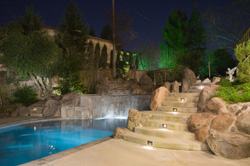 Low voltage transformers convert line voltage power and reduce it's power output so that the energy supplied can be easily supported by an electrical device that requires less power to operate.
 Outdoor Spaces
Fixtures & Uses
- Lighting Fixtures
- Low Voltage Lighting
- Party Lighting
- Wedding Lighting
- Decorative Lighting
- Solar Lighting
Installation & Design


Always consult with a licensed electrician before attempting any outdoor lighting work contained in this website.
Build your own site with Site Build It! | Copyright©2008 www.Creative-Outdoor-Lighting.com
Get your own custom template